Sunday, September 14, 2014

Goan Cuisine-Stories from Goa...Bicholim

She is feisty, outspoken and at 60 plus years of age still working in the cashew sorting factory. Her name is Chandra Venkatesh Prabhugaonkar, and she lives in Gaonkar Vaddo. The interesting part of this vaddo is that we see a balance. We pass through a prominently Hindu dominated section which originally belonged to the Prabhugaonkar’s and on the same road we come across a mosque with the muslim houses. Communal harmony is prevalent throughout, as most shops (which once belonged to Muslim families) are now run by the Hindu Goans.


(Pic Courtesy: Nolan Mascarenhas)

It was interesting talking to Chandra about the past. She was born in Bicholim and married into the Prabhugaonkar family. Her husbands ancestral house with the family deity is just next door, and on Ganesh Chaturti 500 members of the family from all over Goa congregate to celebrate the feast.

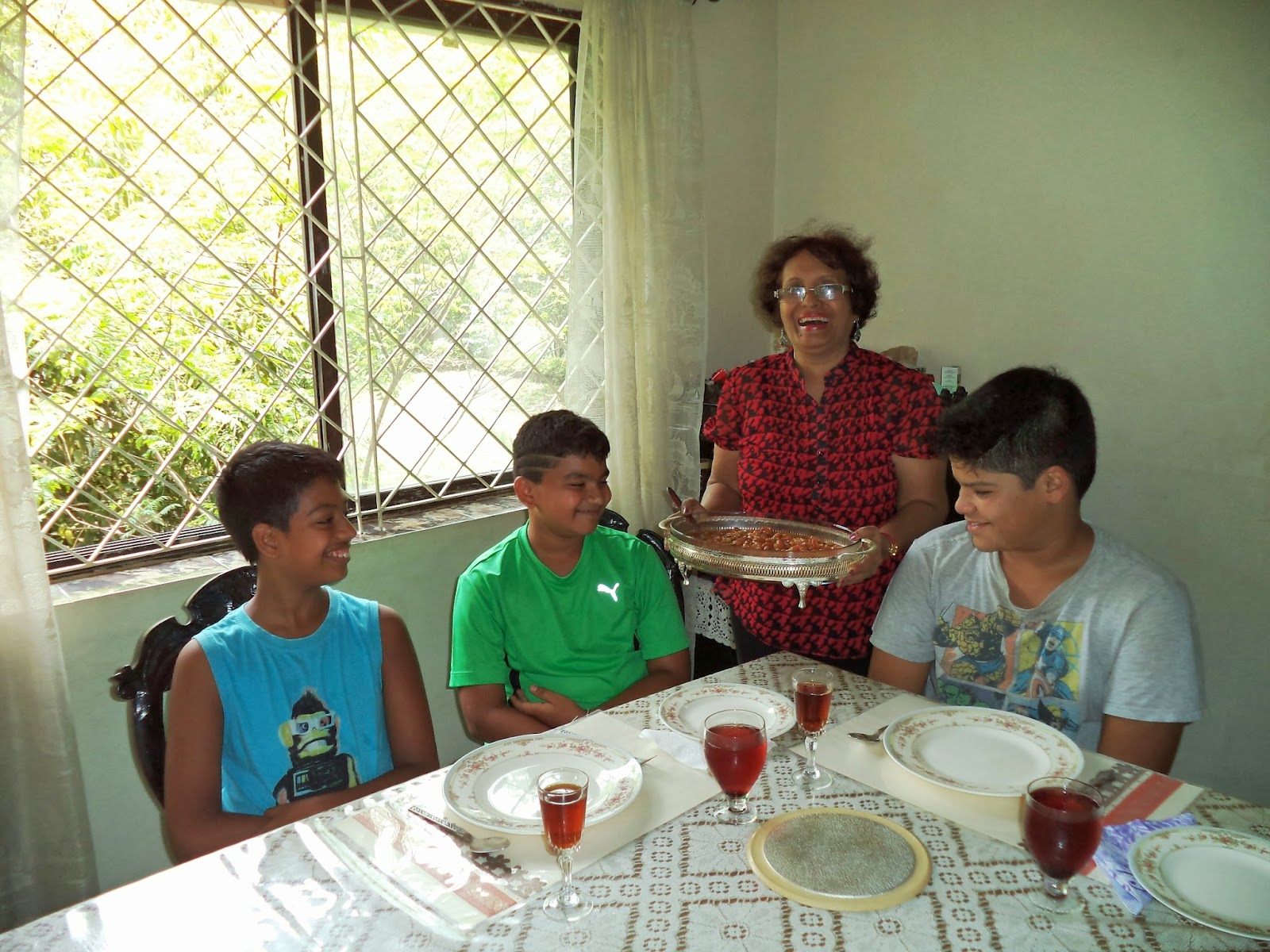
Her two daughter in laws who live with her offer’s us a ‘local’ meal. We take a tour around her small kitchen, the old one still exists as the store room, she demonstrates with her grand daughter Ruthwa watching in fascination how the ‘chool’ was lit with the ‘phukane‘ She still uses the old method of cooking during festivals.

We sit down to reminisce the past with snacks like are chivda and biscuits –the cashew biscuit shaped like a cashew nut and nankattai’s served as tit bits. She has six children three were born at home and three in the hospital. ‘When the time came (for birth) the midwife ‘voigeen’ who stayed close by would come home. The ladies in the house would assist in the birth,’ she says. Those were the days of joint family. Seeing the black chord around her grand daughters neck, we enquire about the same. ‘We had to take them to the dishtkar,’ she says solemnly. ‘There are spirits around everywhere and the child would fall sick often and after the visit to the woman(dishtkar) in Margoa, she would get better’. Yes there was a lot of faith and belief in this ritual.

Food is now served. As we slurp through the rice bhangda hooman (with the fish heads for flavor) and the tails fried with masala, the local vegetable tambdi bhajji accompanied the meal. We learn that as a child Chandra used to work in the cashew factory sorting and grading the cashew nut. ’We were paid Rs 1/- for 15 days,’ she smiles, ‘we would use a bamboo stick to break the outer shell.

Today with a group of local women she works at the factory. Very little has really changed in these vaddos. With a few modern amenities life still carries on as in the past.

While cashew nut is one of the industries that dominates this taluka, Sattari the taluka which we were to visit next is also known for it’s abundant use of the cashew tree. And while lifestyles and status were intertwined with one’s profession, could the next taluka throw a different story? Here is the recipe of the local accompaniment that Chandra served us – Tambdi bhaji. Simple and nutritious. 

(Pic courtesy: Nolan Mascarenhas)

Tambdi bhajji  Preparation: 20 minutes
Red  Amaranth leaves   50 gms,  
Onions  1 no,   
Coconut    ¼ no,    
Green chilies    4 nos,    
Coriander leaves for garnish,  
 Oil     1 tsp

Method: 

Step 1: Chop leaves roughly. Chop green chilies and onions fine.  


Step 2: Heat oil, add chopped onions and chilies with the laves. Fry for awhile. Now add the grated coconut. And cook. Serve sprinkled with coriander leaves.    Optional: can be cooked without oil.


Saturday, September 6, 2014

Goan Cuisine - Stories from Goa…Pernem

I walk into the home of Shubangi and Vaishali Gotge. The mother- in-law daughter-in-law duo love to spend time in their kitchen. They live in a simple ‘middle income’ Hindu Goan house where the kitchen of the past is still retained on the ground floor. Although the upper storied rooms with the main kitchen have undergone modernization, it was a novel experience to soak in the atmosphere of the past. There were many local equipments and implements that our grandmothers used strewn around about the place. Unfortunately the fast paced life (quick fix meals) and smaller rooms in living accommodations (bungalows or flats) do not permit them to be used in many kitchens today.
                                                                                                   
The Gotge’s have lived here for many years, and Ms Shubangi prepares the traditional dishes learned from her mother in law as is the custom. There is one preparation that the locals from Pernem (Pednekars) are proud of and that is the Shagoti. It is believed that the Shagoti’s origin was in this taluka. 


 Pic courtesy: Nolan Mascarenhas 

The women of the Ghotge household put in nineteen  ingredients into this preparation; the chilies include three varieties...the Pernem chili, bedgi chili and green chilies. She agrees that her preparation is spicy as the Pernem chilies impart a ‘spiciness’ to the preparation, but its mouth watering (in more ways than one) – absolutely ‘droolingly’ if such a word exists- good.
 The man of the house, Mr Manohar Ghotge has many interesting stories to tell. Fish was obtained for their daily repast in and around the taluka...Arambol, Mandrem and Morjim (the seaside places) to mention a few.  But many villages in Pernem (away from the sea), did have a way to catch their own fish. This taluka has many water bodies besides the sea, besides the river there are numerous ponds. ‘One way was with the use of a fishing line on which a huge tiger prawn was used as bait’ he informs us. While many of us might consider it a tedious time consuming process for the locals it was a way of life as it was a way used to feed their families. ‘The villagers sometimes strung a net attached to a floating tube across the water (from 4 pm in the evening till the wee hours of the morning), however although the catch would be bountiful it would  not specific to the fish required for the curry,’ he continues. 

Yes there were specific fish to be used for the Hooman. His knowledge keeps us spellbound.  He smiles and adds  ‘and then in small ponds they would use a ‘khand’ (basket) to catch sweet water  fish, but also there would be the adventurous type- who were able to catch the fish with a cloth ‘pagu’. 


These are people who genuinely know and love their fish.


Excerpts from the book – The Culinary Heritage of Goa

Thursday, July 3, 2014

Goan delicacies Bharleli rusch


The Mackeral (Bhangda) is one fish which is found in every Goan household. We see them dried, in a kishmur, fried, masala fried….numerous ways in which they are served in restaurants. But I was on a quest to source a preparation which most restaurateurs do not focus on. And also to find out what the Gen Next feels about the preparation. I was lucky to get all that under one roof…the home of Vaishali Joshi in Vasco 


She had learned the preparation from her mother in law, the late Ms Prema Joshi. The lady was legendary in her Saraswat culinary skills and had imparted that knowledge to her daughter in laws. Joining us was the eldest daughter in law Lalita and the fifth and youngest Monica. And the subject for discussion was the ‘Bharille Bhangde’ (stuffed mackerel) as pronounced in Konkani. Now we are all aware that the mackerel is an oily fish and a rich source of omega 3 fatty acids. Moreover as the flesh of mackerel spoils very quickly, drying and salting is the principal preservation method in Goa for a rainy day. 


Vaishali had ensured that the Gen Next of the Joshi family was present for a discussion on the preparation. Looking at the fat fish (they were stuffed of course) which were tied with a banana stem, on the table on a bed of lettuce I wondered what the youngsters would feel about this traditional preparation. So here they were…. Neha, Charuta, Shamini, Vibhav, Mihir and Rishabh.- Gen Y and Z. What did they feel about Goan food in general…would the cuisine remain the principle focus in the years to come? They were asked. The educated youngsters were keen to air their views. From responses stating that palates and tastes today are flexible as there is a lot of choice, to the fact of unavailability of local ingredients (grated coconut a case in point), to spending half a day in the kitchen cooking……did not augur well for the stability of retaining the Goan cuisine as No ! in most urban household. So I decided to change direction and worked on the subject of ‘fish’…all Goans love their fish don’t they? Charuta confesses that after marriage to a Gujrathi her love for Goan food has increased as her husband loves the cuisine. Neha loves the bharleli bhangda as she loves the stuffing and the crisp taste of the skin. Vaibhav too is partial to the preparation. However, comments ranged from the taste and flavor being a bit too strong to a preference for the Hooman to the bhangda. The Gen Next today knows their minds and their taste buds too.


So what is the future of these delicacies? Lalita relates an anecdote of the past. Her late aunt in law Prafulla Dahanukar had invited Asha Bhonsle to try the preparation. Unfortunately she could not make it due to prior engagements, so Lalita was given the task of packing the bharleli banghda in a container and taking it to the airport where Asha Bhonsle was taking a flight. A few weeks later Lalita received a letter from the singer saying how much she relished the preparation. ‘Our preparations were really tasty,’ Lalita says, ‘and I still have the letter.’


The ‘rusch’ of the past…however times have changed and traditions are slowly dying. Perhaps it is time to ‘strategize’ and re market the excellent ‘rusch’ of our preparations, or else they will slowly be ‘stuffed’ into obscurity.


Goan bread Can one live on bread alone?


Give us today our daily bread….. yes bread does feature in various cultures and even brought the monarchy to become a headless one vide the guillotine when the French Queen Marie Antoinette supposedly said…"Let them eat cake" (Qu'ils mangent de la brioche) upon learning that the peasants had no bread. The story states that since brioche (bread) was enriched with butter and eggs, making it more expensive than bread, the quote supposedly would reflect the princess's obliviousness as to the condition of the people.


And now closer back home, the fate of ‘bread’ hangs in balance. A focus on the 100 year old bakery started by Vincent Pereira and now run by his namesake – grandson Vincent in partnerships one being his brother Anthony. Of the six brothers, only two have retained their ‘skill’ in this field, Vincent catering from this ‘old’ institution for the locals of Taleigao while his brother Anthony has built a bakery at his home to cater to small hotels and eateries (Café Bhonsle, Aram Café, Café Real, Vishal) to name a few.


But let’s go back to the past to understand what ‘bread’ meant to the Goans. It was the Portuguese that brought in the bread to Goa. The Jesuits found that in the coastal area of Majorda, the coconut palm groves produced sur (toddy) in plenty which was a great substitute for yeast. The Chardos of the villages (Varca, Nuvem, Colva and Utorda) learned the profession and the first batch of local Padiero (Poder in Konkani) - bakers were born. ‘Most of the bakers of North Goa migrated from the South,’ says Vincent. His wife Artimisia adds ‘and today we have to substitute the ‘sur’ with yeast due to the non availability of the same.’

We see the poder’s cycle standing in the small balcony of that house. ‘Yes we still do the morning delivery which starts around 5 am,’ states Vincent. ’Our bakery makes Poie, Kankon (bangle shaped bread), quatro (bow shaped), pao and even Undo on order,’ he says. All favorites still being made, we watch locals drop by to pick up their daily bread. So how did the delivery happen in the past? The local poder would garb themselves in old gunny sacks which brought in the flour. In their hand they would carry a stick (with cymbals attached to the top), which they would hit on the floor as they walked, the jangling noise would awaken the residents that freshly baked bread has arrived. The bread basket would then be lifted off his head to the stick which was placed on the ground enabling the customer to pick his choice. Today the invention of the bicycle and the truck horn is the symbol of the modern poder.


Inflation- Vincent remembers a time when his father would operate the bakery. ‘We would
have the bull gado to go to Panjim to pick up the flour, in 1980 a bag would cost us Rs 370/- for approx 90 kgs, ’ he reminisces, ‘today it is delivered here but the cost of the bag is Rs 2040/’. We use zamun wood and a tempo truck which lasts us for around 20 to 25 days costs us Rs 20,000/-‘. We look at the stored wood in the rain covered with blue plastic sheets. There is no place to stock it indoors. Moreover there is a problem of labor too. ‘This job is very labor intensive,’ he mourns, ‘I operate this bakery with 4-5 people. They are from the neighboring state and we have to provide them with salary (Rs5000-Rs 7000) per month, accommodation, food (fish has become so expensive today), cigarettes and even liquor. The locals don’t want a job like this and even the out sourced workers demand their dues.’


The future – We stand in the hot airless environment of the 100 year old house which gives us a glimpse into the past. The power has gone, so the machines were silent and only the old baking oven fuelled by the wood was working. One of the laborers had a torch attached to his forehead as he peered into the narrow aperture of the oven using the long handled spade to remove the baking trays. We were sweating, drenched in our clothes. Vincent had stripped to his waist getting the ingredients ready for the next batch of bread. ‘We make approximately 900 pao’s, 400 poies, 25-50 Kankons and Undo depending on order in 2 batches,’ he explains. With not much space available the bread was airing on gunny sacks placed on the floor. ‘With a lack of subsidy offered by the Government, we find it difficult to operate this place,’ says Armitisia pointing to the leaking roof and the mud walls of the 100 year old place. ‘We sell a bread for Rs 2.40/- wholesale, and Rs 3/- per poie which does not leave much margin of profitability to take care of repairs and maintenance.’ We look at the two sons of Vincent and Anthony who were helping in this enterprise. Would they like to continue this venture? They were asked. A non committal slight shake of the head was the response we received. Perhaps in the near future when it comes to our daily bread, we will follow the dictates of the Queen Marie Antoinette…..let’s eat ‘cake’, as the future of the poder is very much uncertain unless we do something about it.

Wednesday, June 25, 2014

Goan delicacies Stew for Beans


There is no ‘stalk’ in this narrative, though this is a dish one would stalk Maria Lena Sequeira’s house for. Neither is there a Jack – the giant slayer, but there was Kynan Sequeira. Ross Alvares and Jugal Shirodkar the myth slayers….but the beans hold true throughout this narrative, although they vary from place to place- this is all about feijado, the name comes from Portuguese(feijao means beans).

Summer holidays and the three boys were frolicking at home on their skateboard just before lunch. I was here to tell them a story….not about Jack the giant slayer (on the bean stalk the movie was showing at a theatre just then), but about a different kind of bean used in a stew. And Maria Lena who was first introduced to the preparation in Brazil had made it for lunch. What did the boys generally like to have for lunch? I wondered. Out of the mouth of babes, their tastes were international (unfortunately not from Portugal or Brazil). Chicken with Pasta says Ross, Lasagna states Keenan, Maggi noodles says the ever practical Jugal whose family  runs a food catering chain. I decided to come closer to home…what does Mummy make that you like? I ask. Fish curry Ross and Jugal say in unison. Sausages states Keenan. So have you heard about the Feijado I ask taking this cue. The boys shake their heads. 

‘The feijado is served in Brazil and Portugal,’ I began, ‘and also in Goa.’ They look at me politely. Somehow this story is not as exciting as the Maggi noodles jingle. So we all moved to the dining room where Maria Lena’s Feijado stood simmering in the silver plated dish. ‘The typical Brazilian preparation caught my fancy when I visited my sister Lourdes Moniz in Brazil. I had it at the Holiday Inn there and I liked it. They follow the recipe of Emeril Lagasse.’ I look through the recipe; most of the ingredients are available except the black beans, carne seca (salted cured beef) and the hot Brazilian sauce. ‘I substitute Rajmah for the black beans,’ Maria Lena confesses, and in the past I would get salted pork which would be hanging up for sale in a small shop in Panjim. Today I substitute it with bacon; it gives the preparation a nice flavor.’


So what would be the verdict I wondered as I watched the boys spoon the preparation in their mouths? The story through the ages was that this beans preparation was the staple diet of the poor people of Brazil. When the Portuguese gentry finished with their meal, the left over pork trimmings off their plates was mixed with their black beans…a stew of beans called feijoado was created. So what do you all feel? The boys were asked. ‘I like the flavor of the sausage,’ says Ross, ‘it’s tasty,’ says Keenan. Looking at his friends (he does not eat pork) Jugal announces when asked if it will move in his restaurants, “I will tell my father.’

The Brazilians use black beans, they add some vegetables too, in Portugal (northwest mainly Minho and Douro Litoral) white beans are used, while in the north east (Tras os Montes) kidney beans with vegetables like carrots, cabbage and tomatoes are used. Was it difficult to prepare this dish? Maria Lena was asked. In the past it was cooked in a clay pot over a slow fire. She shakes her head. ‘Except for remembering to soak the rajmah overnight,’ she smiles. Tasting our feijado I agree with the boys- this is one preparation one will ‘stew’ for.                                


Monday, June 16, 2014

Goan delicacies Sweet and sour memories…Grandmother knew best


There was something that our grandmothers knew…which slowly will die a natural death. Natural because nature has bestowed on our small state a bountiful harvest which the Gen Next today are not even aware of. So here is a secret shared about something sweet, originally sour at times bitter - the Karmaleanche Goadtik lonche (Kormola (starfruit) chutney/pickle) a Saraswat preparation which was relished as a breakfast accompaniment with polle and perhaps chapattis; today it has vanished from our culinary repertoire.


 Meet Amita Salatry author/TV personality who is determined to keep those recipes alive. But would the Gen Next appreciate those preparations? We were soon to find out with the arrival of Nischita Pednekar a MCA student from Don Bosco and Sai Dhekne a young Asst Professor.

Have you heard of the Karmaleanche lonche? Yes, they did… but they do not eat it at home. Why? First of all It is not easily available (the fruit or the final product), secondly there is not much knowledge about the preparation. So seated in our hosts dining hall with the preparation in front of us the history of the past unfolds. Says Amita as she spreads the ‘lonche’ on the chapatti for her guests ‘a hundred years back nature gave us a variety of seasonal preserves which our grandmothers would pickle for day to day use.’ We hear how throughout the year the trees in the garden would give bimbli, ambade(hog plum), raajaavalla (amla), karmola (starfruit)…a variety of fruit which was pickled and stored. They would have this ‘lonche’ with polle (made of ukhdeache tandull) for breakfast. 


The karmaleanche lonche was cooked over ‘slow’ heat in a special thick bottom metal degchi’s with the help of a halvyache daaul (long handled wooden spoon) as the liquid splattered during the cooking process. ‘Our grandmothers would often use the green fruit (slightly bitter overtones) and cut them into dices,’ Amita says. ‘They would also use green chilies cut into pieces and half the quantity of red chili powder that we use today’. Today with refrigeration the lonche can be preserved for over two years we are informed. Which brings us to an important point ‘what do you have for breakfast today?’ I ask the Gen Next, “mango jam with polle…the polle is still prepared at home; we even make shepuche (dill) polle’’ was the response.


So what could be the reason that this preparation is slowly dying out? ‘It takes about an hour and a half for preparation’ says Amita. What about the tree? With small gardens today would it be possible to grow it? ‘The tree is a low maintenance one,’ she explains, ‘needs little space, no manure and very little water. And moreover the yield is twice a year. The 3/4th ripened fruit are used for the preparation, and we will always use Shankar brand rock type hing.’ ‘It would nice if this ‘lonche’ is served at wedding meals, it would create awareness amongst everyone,’ murmured the Gen Next, ‘better than using ordinary jam as jaggery is much healthier than the sugar used.’


Wise words indeed….our culinary legacy was variety, taste as well as health. As we listen to Amita regarding the way this ‘lonche’ is made we also learn that she uses it for uddamethi too. Rather than mother knows best…our grandmothers knew better too.